When your foundation loses its perfection, the first suspect almost always falls on the brush in your hand. However, before replacing your favorite brush, it's important to clearly distinguish between two different beauty scenarios:
- The tone is rolling: pellets and flakes form, and the product literally comes off in pieces when touched.
- The tone is collected in the texture: there are no lumps, but the product settles in pores and facial wrinkles.
In fact, it's not just the foundation brush that can cause such troubles. Much more often, the main culprits are gaps in skin preparation, a conflict between the formulas of the primer and foundation, an SPF layer, or too intense movements during makeup. Let's look at all the details in order.
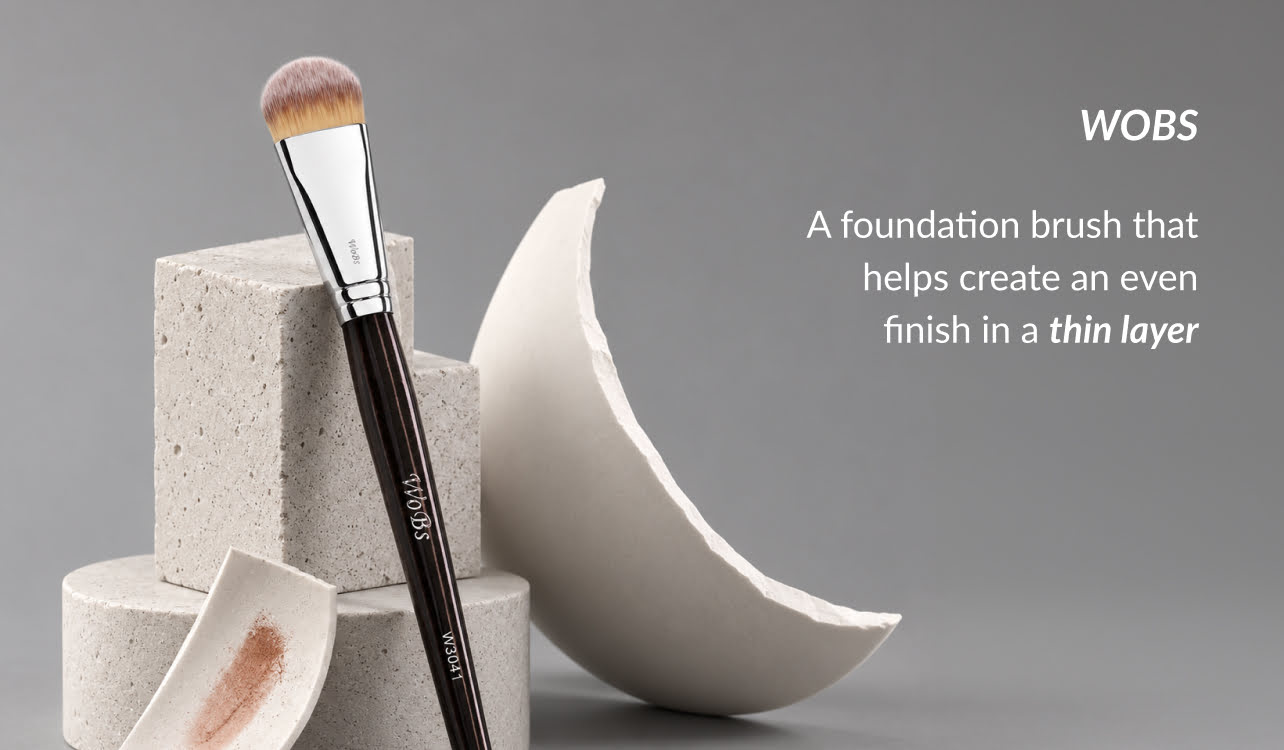
Step-by-step algorithm: how to properly apply foundation with a foundation stick?
To make the coating look weightless and not flaky, our online makeup brush store WoBs advises you to follow several important rules.
Preparing the base: how do the stages of facial skin care affect makeup?
Properly completed skin care steps are the key to staying hydrated. The base should be moisturizing but not too oily. Wait 3–5 minutes after serum or cream, and 10–15 minutes after SPF. If your skin remains sticky, it’s too early to apply foundation.
Correct technique: what movements should you avoid when using a foundation brush?
Even a good foundation brush will cause clumps if you rub your face too hard. Chaotic movements will detract from your care. Apply the product with gentle pressing or blending movements without pressure.
Quantity control: how does a foundation applicator dispense product?
Excess product tends to collect in the texture. Our life hack is to layer the foundation in microdoses. A foundation applicator in the form of a duofiber, flat-fluffy or beveled tuft will do a great job of this.
Formulas and compatibility: why does foundation roll off?
If your technique is perfect, but you're still looking for an answer to why your foundation is rolling off, the reason may lie in a formula conflict or too harsh care. Therefore, it's important to evaluate the entire sequence of skin preparation, and our article will tell you how to achieve the "second skin" effect and which foundation brush to buy for this.
By taking into account all these little things — from the pauses between care steps to the force of pressure — you will easily master the secret of how to properly apply foundation with a foundation stick for an even and natural finish!
Foundation stick: buy from Vobs for different skin types
When choosinga brush for applying foundation , always consider your skin type and condition:
- Dry and sensitive: don't rub it with a dense bristle to avoid irritation or peeling - a soft duofiber or delicate synthetic foundation brush is better suited, which we recommend buying with a flat cut.
- Oily and combination: too loose bristles work worse on pores, so a dense kabuki with a flat or rounded cut would be the best choice.
That's why Ukrainian makeup brush manufacturer Vobs takes care of the comfort of every stroke, combining high-quality taklon and thoughtful ergonomics - from voluminous models for quick toning to compact beveled options for hard-to-reach areas.
So when you need a high-quality foundation brush that you can buy quickly and conveniently, our catalog will help you find a favorite for any beauty task. Choose makeup brushes from the WoBs brand and create perfect coverage without any rolling!
Dry, cream, and liquid products all have different consistencies and require different amounts of coverage. One brush can pick up too much product, leave streaks, or spread product unevenly. That’s why it’s important to have the right bristles for each formula.
A fluffy brush with soft natural or high-quality synthetic bristles is good for powder, blush, and bronzer. This shape picks up a small amount of product and evenly disperses it, creating a light coating without harsh edges.
For cream formulas, it is convenient to use a denser synthetic brush, which controls the application well and does not absorb excess product. For liquid products, a duofiber is suitable: it evenly distributes the product and allows you to create a thin layer.
The WOBS catalog features models with different bristle densities for different makeup techniques. A dense brush carries more product and provides richer coverage, a medium density is suitable for controlled application and blending, and a fluffy one creates a lightweight finish.