The skin on the face has a different anatomy and relief. Trying to distribute the tone with the same wide movements will lead to the fact that in the moving areas it will instantly slide. The cheeks and forehead are relatively flat planes, while the wings of the nose, nasolabial folds and the area under the eyes have natural depressions, enlarged pores and active facial expressions, where cosmetics easily accumulate. And a large brush, due to its size, simply will not reach hard-to-reach bends. Let's figure out how to properly apply foundation in micro-zones and which brushes for applying foundation will turn complex areas into a perfectly smooth coating!
Detailing Secrets: How to Properly Apply Foundation with a Blush for a Weightless Finish
Creating high-quality coverage in difficult areas requires jeweler's precision. And our makeup brush brand Wobs has prepared a simple guide on how to properly apply foundation so that it goes on weightlessly and doesn't smudge throughout the day.
Which foundation brush is suitable for details?
For small areas, it is not just the small size that is important, but the precise cut and elasticity. A flat or beveled foundation brush with short, densely packed bristles is perfect for this task - it works comfortably in the creases near the nose and does not bend when pressed. And more about how a synthetic foundation brush, which is advisable to buy for working on large surfaces, differs from models for jewelry detailing, read our separate article .
How to use foundation in the creases?
The main secret to using foundation around the eyes and nose is to use as little product as possible. Apply the foundation in small dots and blend with light, pressing movements. For these areas, the product residue on the bristles is often enough.
How to make foundation fit well on the skin?
When figuring out how to make foundation fit well on the skin in areas with pronounced relief, consider the following nuances:
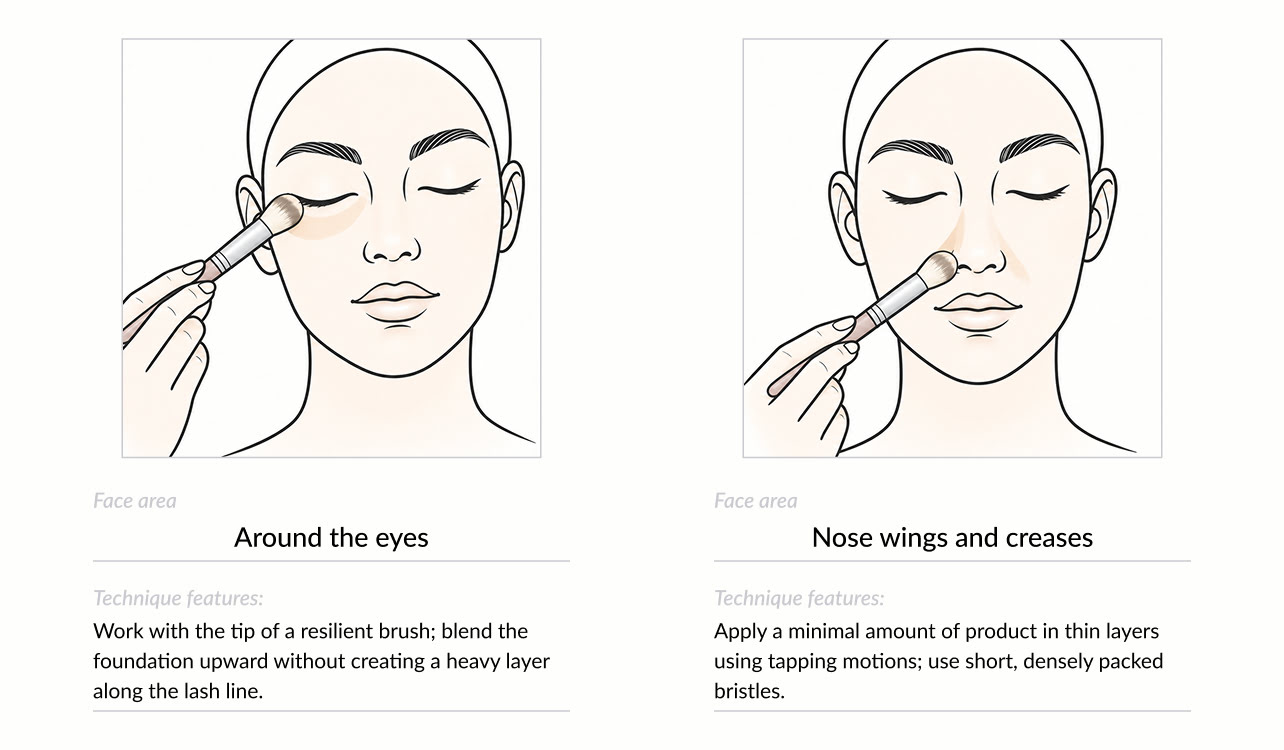
- Inner corner of the eye: Use the tip of a fluffy brush. To avoid creating a heavy layer under the eyes, don't apply too much product to the lash line—blend it upwards.
- Nasolabial folds: Apply a thin layer of foundation using tapping movements. If the product rubs off near the nose, set the area with a pinch of loose powder.
By using the right brush to apply foundation, you can easily achieve the desired effect.
The perfect foundation applicator: buy from Vobs for delicate areas
If the tone has crumpled, don't layer your makeup. Take the same brush, but without an extra portion of product, and use light sweeping or blotting movements to go over the creases—the dense pile will act like a sponge and absorb the excess.
If you are looking to buy a foundation applicator specifically for such jewelry beauty tasks, we will help you find the perfect solution! From a weightless fluid to a dense evening finish - the manufacturer of makeup brushes Wobs creates models from high-quality Taklon to embody any ideas. We carefully select the shape, density and elasticity of the bristles for different techniques and textures, so that each foundation applicator, which you can buy on our website, gives control over every movement.
Browse the catalog , choose makeup brushes in the Vobs online store and enjoy flawless skin every day!
Use a small, rounded or pointed brush. Apply the foundation in a thin layer using light, pressing movements, without stretching the skin. It is better to work with a minimal amount of product under the eyes, gradually blending it out to the edges.
For the wings of the nose, it is convenient to use a small flat or beveled brush with dense, elastic bristles. Apply a minimal amount of foundation pointwise, and then distribute it in the folds with light pressing movements, without overloading the skin.
For micro-areas, choose a small brush with short, dense, and elastic bristles. WOBS has compact flat and angled models that are convenient for applying tone near the wings of the nose, in the creases, and around the eyes.
If the tone has collected in the crease, do not add a new layer. Take a clean brush with a small amount of residual product on the bristles and use light pressing or sweeping movements to remove the excess. Blend the edges gently.